
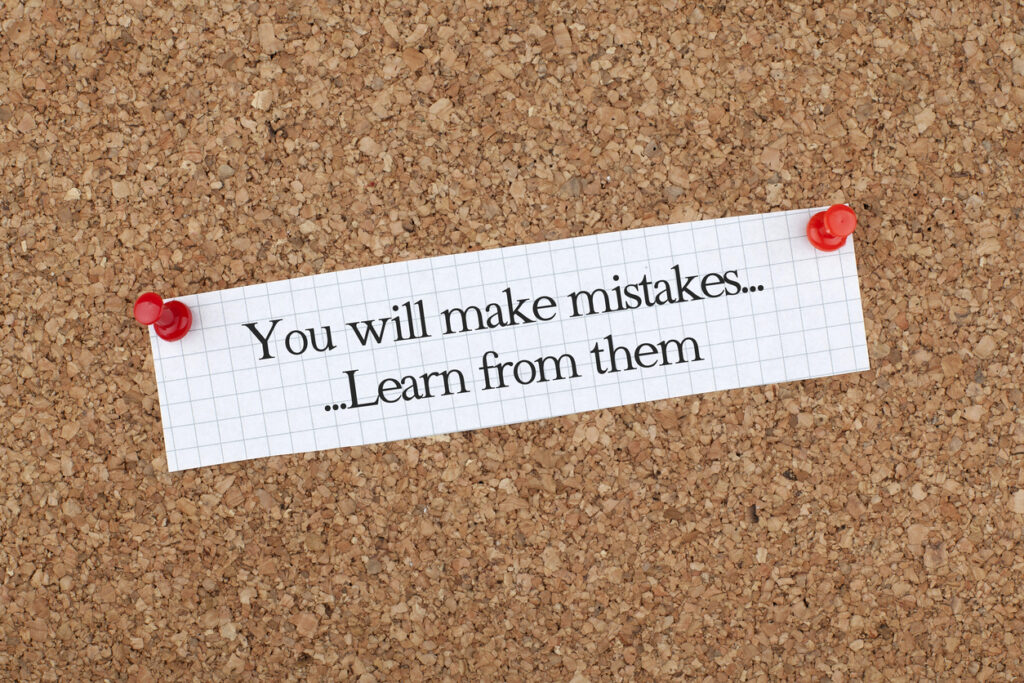
We all understand, the more at bats opportunities you have, the more hits you can have. A major goal of increasing your error budget is to allow you to take more swings by allowing you to fail safely. The purpose is to reduce fear-induced cognitive load that drains creative energy and increase exposure to edge conditions, the exciting boundary where real learning, real progress occurs. Increasing the error budget expands our behavioral repertoire and we dare to introduce novel approaches we would otherwise hesitate to attempt.
The idea is to reduce the ‘cost’ of errors, emotional and financial. Most progress is iterative, building on lessons learned when we move forward and the faster we can intelligently move forward, the greater our growth and productivity. The vital key is to ‘fail intelligently’ i.e. each effort forward is the result of a well-designed, well-thought-out process. Repetition, continued effort, without feedback and thoughtful, structured reflection, is just busyness.
To be clear, increasing your error budget is NOT lowering the bar, allowing sloppy thinking, reducing accountability, or tolerating repeated identical mistakes.
To work, increasing the error budget requires the willingness to adopt strict, counterbalancing discipline.
Yes, we can learn faster the more we attempt BUT only if we have a rigorous analytical process, only if we wring all the lessons out of each mistake before proceeding onward. We prefer small mistakes, fast mistakes, transparent mistakes, and only new errors. Whenever possible, we prefer to have our stumbles occur during practice runs, simulations, role-playing, internal drafts, controlled tests, pilot programs, and low-cost prototypes.
Closing Quotes:
“The most important thing is to be willing to be wrong.” – Andy Grove, Intel
“The only real mistake is the one from which we learn nothing.” – Henry Ford
“Success is not about avoiding failure. It’s about learning from it.” – Naveen Jain
“There is no innovation and creativity without failure. Period.” – Brené Brown, Dare to Lead
“The better a man is, the more mistakes he will make for the more new things he will try.” – Peter Drucker, Good to Great
“Mistakes are not a necessary evil; they are the price of doing something new.” – Edwin Catmull, former president of Pixar
“Failure is instructive. The person who really thinks learns quite as much from his failures as from his successes.” – John Dewey, How We Think, 1910
“If you’re not failing, you’re not innovating enough. Our success at Amazon is a function of how many experiments we do per year, per month, per week.” – Jeff Bezos
As always, I share what I most want and need to learn. – Nathan S. Collier
Note: Every effort has been made to properly source any 3rd person material. I am, however, a voracious reader. If anyone finds any unattributed material, pls let me know asap and I will be delighted to give credit where credit is due.
“All intelligent thoughts have already been thought; what is necessary is only to try to think them again.” – Johann Wolfgang von Goethe, 1749-1832