“The English word ‘spell’ comes from the Proto-Germanic *spellą, which simply meant ‘to speak’, ‘a story’, or ‘a narrative’. To spell a word with letters and to cast a spell over an audience come from the exact same root.” – ChatGPT
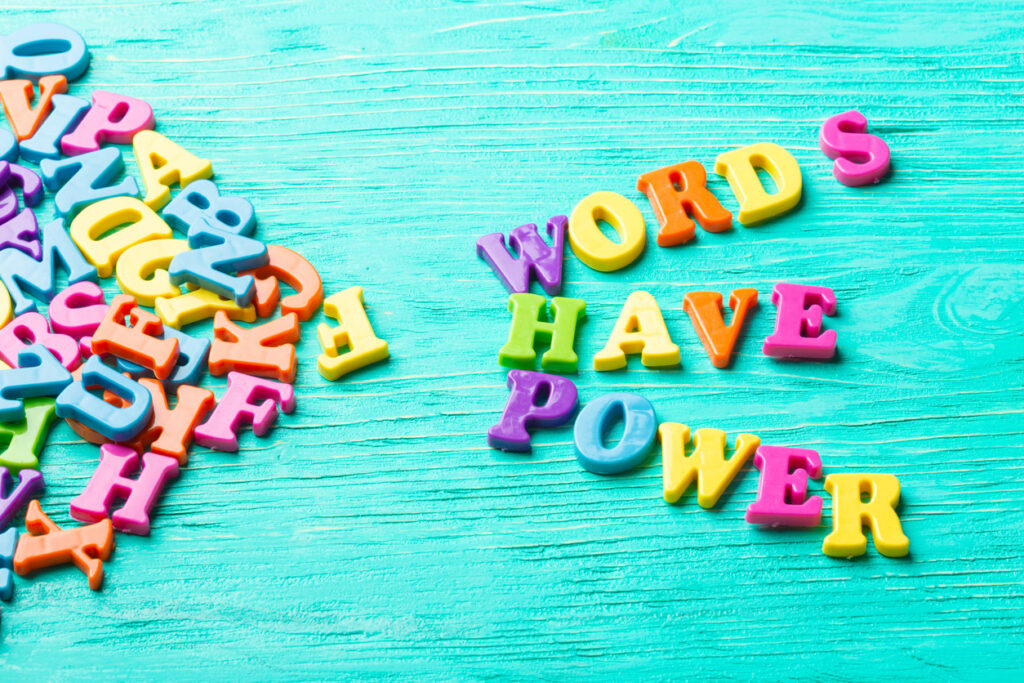
Because we are surrounded by words and constantly bombarded by a barrage of terms, phrases, and various expressions, we lose awareness of the cumulative impact that words have on our emotions, thoughts, and world views. In ways small and large, words cast spells: they evoke emotions and create mental models. Words like ‘always, never, everyone, and impossible’ cut off possibility; other words like ‘sometimes, usually, and often’ leave the door of the mind open.
Words do far more than describe reality—they are the lens through which we create our personal reality: ‘90% survival rate’ versus a ‘10% failure rate’ describe the same reality yet we humans tend to respond differently.
The power of suggestion can cause repeated statements to become internal scripts that act as mental programing. Furthermore, the mind tends to substitute repetition for proof as familiarity breeds belief. Widespread adoption by others, especially by authority figures, triggers social proof irrespective of accuracy, validity, or objective facts. Giving an experience a name can organize our experiences, create a mental peg to hang them on, a shelf to place them on, and thus to deal better with what otherwise may be confusing or upsetting. However, it is a two-edged sword: while naming can help, labels can imprison.
Awareness, healthy skepticism, and robust critical thinking skills are vital to maintaining mental health and a clear world view. The wise stand guard eternally at the entrance to the mind.
Closing Quotes:
“If you realized how powerful your thoughts are, you would never think a negative thought.” – Peace Pilgrim, 1908-1981
“Of all the talents bestowed upon men, none is so precious as the gift of oratory. He who enjoys it wields a power more durable than that of a great king.” – Winston Churchill, 1874-1965
“Words: So innocent and powerless as they are, as standing in a dictionary, how potent for good and evil they become in the hands of one who knows how to combine them.” – Nathaniel Hawthorne, 1804-1864
As always, I share what I most want and need to learn. – Nathan S. Collier
Note: Every effort has been made to properly source any 3rd person material. I am, however, a voracious reader. If anyone finds any unattributed material, pls let me know asap and I will be delighted to give credit where credit is due.
“All intelligent thoughts have already been thought; what is necessary is only to try to think them again.” – Johann Wolfgang von Goethe, 1749-1832