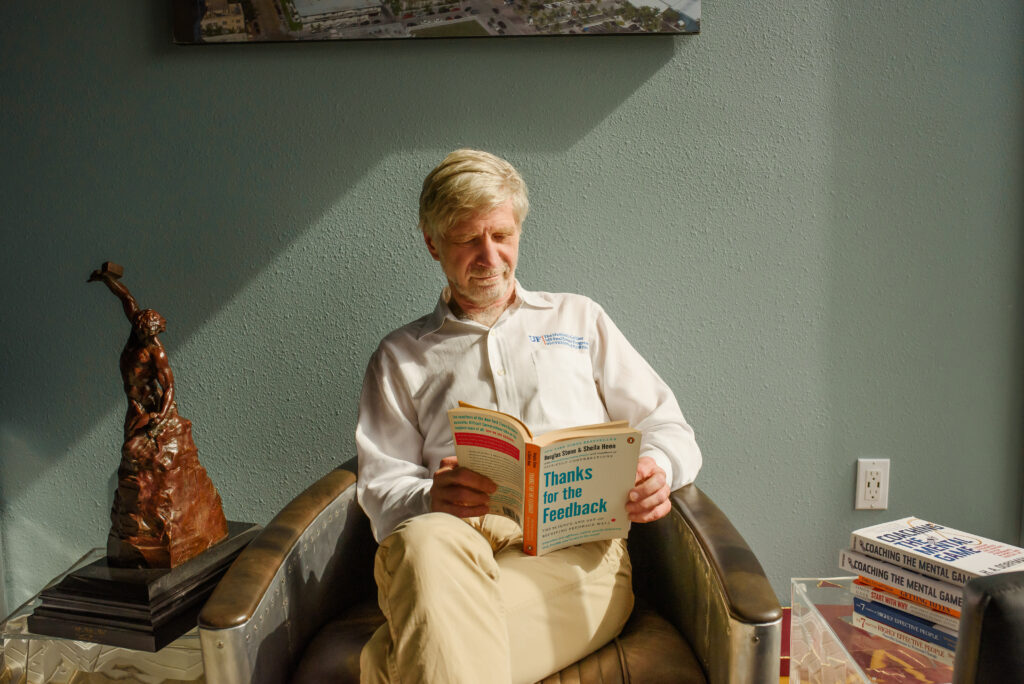

We are talking about Tacit Knowledge: intuitive, unwritten ‘know-how’ acquired by personal experience, practice, and trial-and-error. The unwritten rules, implicit problem-solving methods, and nuances/subtleties that are acquired through apprenticeship, experience, observation, repetition, and feedback that lead to wisdom and good judgment and yet are challenging to fully explain, formalize, or write down i.e. they resist easy documentation. Tacit knowledge kicks in when a cost estimate ‘feels wrong’ or sensing when a renter issue is likely to escalate, or perceiving when a deal is becoming risky, when something feels ‘off’. Tacit knowledge is accumulated pattern recognition combined with common sense.
Explicit knowledge can be readily codified and transmitted: formulas, procedures, checklists, manuals, policies, financial models, zoning regulations: all important yet with inherent limitations. A physicist can write out the differential equations governing balance, gyroscopic torque, and steering adjustments needed to stay upright on a bike… none of which will help a child to ride a bike.
Tacit knowledge is often the scarcest asset to replicate. Manuals and software scale; judgment and skill do not, except through people working together long enough. That is why turnover, offshoring, or ‘document everything’ programs so often fail to capture what actually makes a team good. AI struggles to replicate tacit knowledge because it lacks embodied physical presence, real-time sensory perception, and human emotional context.
Organizations often underestimate how much expertise resides in team members’ tacit knowledge. When a long-time veteran retires, explicit files may remain on the server, but the judgment required to interpret them walks out the door. You lose thousands of small judgments about what matters, what to notice, whom to call, what usually goes wrong, and when an exception should be made.
Closing Quotes:
“Experience is the teacher of all things.” – Julius Caesar
“We can know more than we can tell.” – Michael Polanyi
“For the things we have to learn before we can do them, we learn by doing them.” – Aristotle
“Before I learned the art, a punch was just a punch. While I was learning the art, a punch was no longer a punch. After I understood the art, a punch was just a punch.” – Bruce Lee
“The situation has provided a cue; this cue has given the expert access to information stored in memory, and the information gives the answer. Intuition is nothing more and nothing less than recognition.” – Herbert Simon
As always, I share what I most want and need to learn. – Nathan S. Collier
Note: Every effort has been made to properly source any 3rd person material. I am, however, a voracious reader. If anyone finds any unattributed material, pls let me know asap and I will be delighted to give credit where credit is due.
“All intelligent thoughts have already been thought; what is necessary is only to try to think them again.” – Johann Wolfgang von Goethe, 1749-1832